HIV-1 & HIV-2: From Diagnosis to Vi...
21 Oct,2026


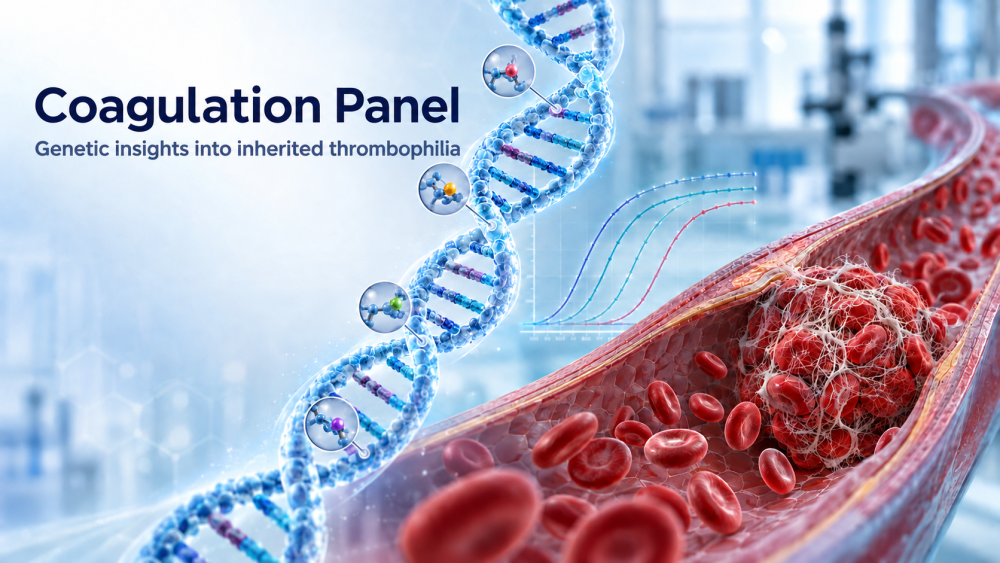
Blood clotting is a balancing act. Clot too little and a minor injury becomes an emergency. Clot too much and the same machinery starts blocking healthy vessels — in the deep veins of the leg, in the lungs, sometimes in the placenta. For most people that balance holds. For a significant minority, it is tilted from birth by a handful of inherited variants they will never know about until something goes wrong.
Venous thromboembolism is among the most common cardiovascular conditions worldwide, and many first episodes occur without an obvious trigger. When a clot appears in a young patient, recurs without explanation, or runs in a family, the question stops being what happened and becomes why this person.
Acquired risk factors — surgery, immobilisation, malignancy, pregnancy, oestrogen-containing contraceptives, are usually visible in the history. Inherited thrombophilia is not. It is present from conception, silent for decades, and invisible to routine screening: a normal PT and aPTT say nothing about it. Most of that inherited risk traces back to a small number of well-characterised variants.
Factor V Leiden (G1691A). Activated protein C normally inactivates Factor Va and shuts the cascade down. This single base change alters the cleavage site, leaving a Factor Va that resists inactivation — activated protein C resistance. It is the most common inherited thrombophilia in European populations (roughly 3–8%), rarer in South Asian, East Asian and African populations. Risk rises sharply when it meets an acquired trigger such as contraception, pregnancy or orthopaedic surgery.
Prothrombin G20210A (Factor II). This variant sits in the 3' untranslated region and doesn't change the protein at all. It makes mRNA processing more efficient, leaving carriers with elevated circulating prothrombin — more substrate for thrombin generation. Found in about 1–2% of European populations. Its real significance is combinatorial: a patient carrying both Factor V Leiden and G20210A faces considerably higher risk than either variant alone, which is why testing one marker in isolation can mislead.
MTHFR (C677T and A1298C). These variants reduce enzyme activity in folate metabolism and can raise plasma homocysteine. Worth being straight about: major professional bodies now advise against routine MTHFR genotyping in a standard thrombophilia workup, since genotype alone predicts thrombotic events poorly. Its value sits in a narrower frame — evaluating folate–homocysteine metabolism, interpreting a documented raised homocysteine, or building a fuller metabolic picture in reproductive medicine. Reported alongside Factor V and Factor II with that context attached, it informs; reported alone as a clot-risk verdict, it doesn't.
Genotyping earns its place when the result could change management: unprovoked VTE at a young age, recurrent events, thrombosis at unusual sites, strong family history, recurrent pregnancy loss under investigation, or counselling at-risk relatives before contraception or pregnancy. DNA-based testing has a practical edge over functional assays here — the genotype doesn't shift with acute thrombosis, anticoagulation or sampling time.
Running the three markers separately means three aliquots, three runs, three sets of controls and an answer arriving in instalments. Since the combinations carry different clinical weight than the individual variants, the complete genotype is the actual deliverable.
The kit detects Factor II (Prothrombin G20210A), Factor V Leiden (G1691A) and MTHFR (C677T and A1298C) from a single sample in one run. Allelic discrimination chemistry gives clean, reproducible genotype calls; sensitivity reaches 2% mutant allele in a 98% wild-type background; and wild-type amplification in every reaction acts as a built-in check on DNA quality, so a failed extraction declares itself instead of passing as a negative.
| Cat. No. | Product | Format |
| 3B1400 | TRUPCR® Coagulation/Thrombophilia Panel Kit | 24 reactions |
| 3B1399 | TRUPCR® Coagulation/Thrombophilia Panel Kit | 48 reactions |

21 Oct,2026

13 Oct,2026

22 Sep,2026

15 Sep,2026

08 Sep,2026
3B BlackBio Biotech India Limited is now 3B BlackBio Dx Limited as a result of amalgamation with it's parent company Kilpest India Limited. 3B BlackBio Dx is a leading Indian company in the field of PCR based Molecular Diagnostic Kits. We offer technical support and training on all our products and are committed to increasing the efficiency of laboratory testing and enhancing patient care.
The Company is ISO 13485:2016 certified, GMP compliant biotech R&D organization.
General enquires: info@3bblackbio.com
Corporate Enquiry:
+91 9691680693,+91 9810562700
Orders: info@3bblackbio.com
Tel: 0755 - 4076518, 4077847

Register now and receive latest product updates and important announcements directly in your inbox